
To get cited by Bing Copilot, you need to clear three hurdles: make sure Bing can index your pages and enable IndexNow for faster updates, rewrite key sections so each heading answers its question in the opening sentence, and add FAQ or HowTo schema that matches your visible content. Most citation failures stem from indexing problems rather than poor writing, so verify your pages appear in Bing search before investing time in content rewrites.
30 Day Checklist to Optimize for Bing Copilot Citations
If Bing cannot index your pages and your sections are not passage-ready, Copilot cannot cite you. Getting cited now depends on three levers: confirm Bing indexing and enable IndexNow, rewrite key sections so each H2 answers its question in the first sentence, and add FAQ or HowTo schema that matches what is visibly on the page. Run a free check at cited.best/audit to see where you currently stand.
***
TL;DR: >- Ensuring your pages are indexed by Bing and enabling IndexNow can significantly improve your chances of being cited by Copilot.- Writing passage-first, answer-driven content with clear structure, short sentences, and matching schema boosts citation eligibility.- Confirm your robots.txt allows BingBot and IndexNow is active before focusing on passage rewriting or schema optimization.- Regularly verify that your content is visible in Bing search with unique phrases to identify indexing issues early.- Monitoring AI Performance data in Bing Webmaster Tools helps track citation patterns and guides ongoing content improvement efforts.
***
Table of Contents
- What Copilot and Bing prioritise when selecting citations
- Technical checklist: ensure Bing can find and re-index your pages
- Write passage-first, snippable content Copilot can lift
- Schema and structured data that increase grounding eligibility
- Validate and measure Copilot visibility: what to track and how to diagnose issues
- 30-day action plan: step-by-step tasks to improve Copilot eligibility
- Perspective from Cited: how we audit and fix the highest-impact issues
- How to leverage AI-generated suggestions from Bing Copilot to improve content
- Strategies for integrating Bing Copilot insights into SEO workflows
- Common pitfalls and troubleshooting when optimizing for Bing Copilot
- Impact of Bing Copilot optimization on user engagement metrics and ranking
- What actually matters, and what conventional SEO advice gets wrong
- Why book Cited's free AI visibility audit
- Sources
- FAQ
What Copilot and Bing prioritise when selecting citations
Copilot does not crawl the web itself. It draws from Bing's index, which means a page absent from Bing cannot appear in a Copilot answer, no matter how well written it is. This is the retrieval gate, and it filters out most of the internet before synthesis even begins.
Once a query reaches Bing, Microsoft's own Prometheus system rewrites the conversational question into shorter sub-queries, typically three to five words, and ranks passages against those fragments rather than the page as a whole. A page can rank for its main keyword yet still lose the citation if the specific paragraph answering the sub-query is buried or vague.
Three factors decide what gets lifted from there:
- Freshness: recently updated pages with visible dates carry more weight in fast-moving topics.
- Corroboration: claims repeated across multiple credible sources reduce Copilot's citation risk.
- Entity clarity: pages with unambiguous authorship and organisation markup synthesise more cleanly than anonymous ones.
Copilot's interface now surfaces citations as clickable source links with an aggregated source list, which raises the stakes for publishers whose passages are ambiguous or poorly attributed. Vague, unsourced writing simply has fewer places to grip.
Technical checklist: ensure Bing can find and re-index your pages
Copilot's citation eligibility starts with a boring truth: most failures are indexing failures, not writing failures. Work through these in order.
- Open Bing Webmaster Tools and confirm your priority pages are indexed; submit or resubmit your XML sitemap if coverage gaps appear.
- Check robots.txt allows BingBot and OAI-SearchBot explicitly, and make a deliberate call on GPTBot rather than leaving it blocked by default.
- Enable IndexNow so updates reach Bing within minutes instead of waiting for the next crawl cycle.
- Audit canonical tags and redirect chains. A page redirecting through three hops rarely gets crawled cleanly.
- Remove NOCACHE and DATA-NOSNIPPET tags from any page you want cited. Both directives can quietly limit Copilot's ability to quote your content, even when the page is indexed fine.
Pro Tip: Search "site:yourdomain.com" plus a unique phrase from a page you expect to rank. If it doesn't appear, stop writing new content and fix indexing first, because no amount of passage rewriting fixes a page Bing cannot see.
For a deeper technical walkthrough, our guide to technical SEO for AI covers crawl budgets and structured logging in more depth.
Write passage-first, snippable content Copilot can lift
Each H2 and H3 on the page should work as a standalone answer, because Copilot selects passages, not full articles. Open every section with the direct answer in sentence one, then support it. A heading followed by three sentences of throat-clearing before the actual point rarely gets quoted.
Short, fact-dense sentences outperform long, clause-heavy ones for this purpose. Bulleted lists, labelled examples, and named tools give Copilot's synthesis layer something concrete to extract rather than paraphrase. This is exactly what Microsoft's own guidance on inclusion in AI answers recommends: modular, passage-level content alongside classic indexing basics.
Practical rules that hold up across most sites:
- Write the FAQ answer in one or two sentences, not a paragraph that meanders before the point.
- Structure HowTo content as genuinely sequential steps, because Copilot often lifts these near-verbatim.
- Keep critical facts in visible HTML text, not locked inside images, since alt text is a weak substitute for real copy.
Pro Tip: Rewrite your top three H2s as if answering a voice search in under 15 words. If you can't, the passage is too diffuse to be citation-ready.
Schema and structured data that increase grounding eligibility
Structured data helps Copilot match your passages to the right query, but only when it mirrors what's actually on the page. Mismatched or inflated schema does more harm than none at all.
Focus on the types that carry real weight for AI grounding:
- Organization and Author schema, with named authors and clear organisational identity, since Copilot's synthesis rewards unambiguous entities.
- Article schema with accurate publish and modified dates, which feeds directly into the freshness signal.
- FAQPage and HowTo schema that matches the visible questions and steps word for word, not a paraphrased version.
Test every implementation with Google's Rich Results Test and Bing's own markup validator before publishing. Never mark up content that doesn't exist visibly on the page. Microsoft has been explicit that inclusion depends on structured data reflecting genuine, question-aligned passages, not decorative tags bolted on for SEO theatre.
Validate and measure Copilot visibility: what to track and how to diagnose issues
The clearest signal now comes directly from Microsoft. AI Performance in Bing Webmaster Tools shows which URLs have been cited in Copilot and other AI answers, plus the query phrases that triggered them.
Beyond the dashboard, run your own checks:
- Ask Copilot neutral, non-branded questions related to your topic and note which domains it cites, since this reveals your real competitive position rather than a branded vanity search.
- Cross-reference IndexNow submission logs against your coverage reports to confirm updates are actually reaching Bing.
- Track whether cited passages match the exact section you optimised. A citation pointing to the wrong paragraph on your own page tells you the passage structure still needs work.
If Copilot cites competitors on queries you rank for in classic Bing search, that's a synthesis problem, not a retrieval one, which points you straight back to passage structure rather than indexing.
30-day action plan: step-by-step tasks to improve Copilot eligibility
Spread the work across four weeks rather than attempting it all at once.
- Week 1: Confirm indexing status in Bing Webmaster Tools, fix robots.txt for BingBot and OAI-SearchBot, enable IndexNow, and resubmit your sitemap.
- Week 2: Rewrite your three highest-value pages into passage-first format and add FAQ or HowTo schema that mirrors the visible copy.
- Week 3: Refresh evidence and statistics on those pages, update visible dates, and pursue corroborating mentions from other credible sites in your niche.
- Week 4: Run neutral Copilot prompts against your priority queries, check AI Performance data, and adjust whichever pages still aren't surfacing.
Repeat the cycle monthly. Citation eligibility isn't a one-off fix, it drifts as competitors update their own content and as Bing's index refreshes.
Perspective from Cited: how we audit and fix the highest-impact issues
Every audit Cited runs starts in the same order: indexing, then schema, then passage structure, then authority signals. That sequence exists because fixing passage writing on a page Bing hasn't indexed changes nothing.
The most common finding is not bad writing. It is blocked crawlers, missing IndexNow, or FAQ schema that doesn't match the visible page. Once those gates are cleared, we restructure the specific passages most likely to answer real queries and tighten the authority signals around them. If you want to see where your own site stands before paying for anything, start with the free audit at cited.best/audit.
How to leverage AI-generated suggestions from Bing Copilot to improve content
Copilot's own answers are a free content gap analysis if you know how to read them. Ask it a question your business should be answering, and study exactly which passage it pulls, from whom, and why.
If a competitor's shorter, blander page gets cited over your more detailed one, the gap is usually structural. Their answer probably sits in the first sentence of a heading; yours is likely buried under context and caveats. Reorganise the passage rather than rewriting the whole page from scratch.
Pay attention to the phrasing Copilot uses in its synthesised answer. It often mirrors the exact language of the cited source closely, which tells you what vocabulary and framing Bing's ranking layer rewards for that query. If Copilot consistently phrases things using terminology absent from your page, that's a vocabulary gap worth closing, not just a content gap.
Watch which format Copilot favours for a given query type. Comparison queries tend to pull tables; process queries pull numbered steps; definitional queries pull a single clear sentence. Match your content's format to what Copilot is already choosing to display, rather than guessing at a generic structure.
Treat this as an ongoing input, not a one-time audit. Query behaviour and citation patterns shift as Bing updates its ranking signals and as competitors adjust their own pages, so revisit the same test queries every few weeks and note what changes.
Strategies for integrating Bing Copilot insights into SEO workflows
Copilot visibility works best when it sits inside existing SEO workflows rather than running as a separate side project. The teams that get the most out of it treat citation tracking as another content KPI, alongside rankings and organic traffic, not a novelty metric checked once a quarter.
Build Copilot citation checks into your existing content review cadence. When you audit a page for keyword performance, run the same neutral Copilot prompts you'd use to test citation eligibility, and log whether the page is cited, ignored, or losing ground to a competitor.
Feed findings back into your editorial brief templates. If passage-first structure keeps winning citations across your test queries, make "answer in sentence one" a standing requirement in every brief, not an occasional reminder.
Assign clear ownership. Technical fixes like robots.txt and IndexNow usually sit with a developer or technical SEO specialist, while passage rewriting sits with content writers. Splitting the work without coordination is the most common reason optimisation stalls: the technical layer gets fixed, but nobody follows up on the writing, or vice versa.
Finally, connect this work to your broader content optimisation strategy rather than treating Copilot as an isolated channel. The same passage-first, well-sourced writing that earns a Copilot citation tends to perform better in classic Bing rankings too, because both systems reward clarity and corroboration.
Common pitfalls and troubleshooting when optimizing for Bing Copilot
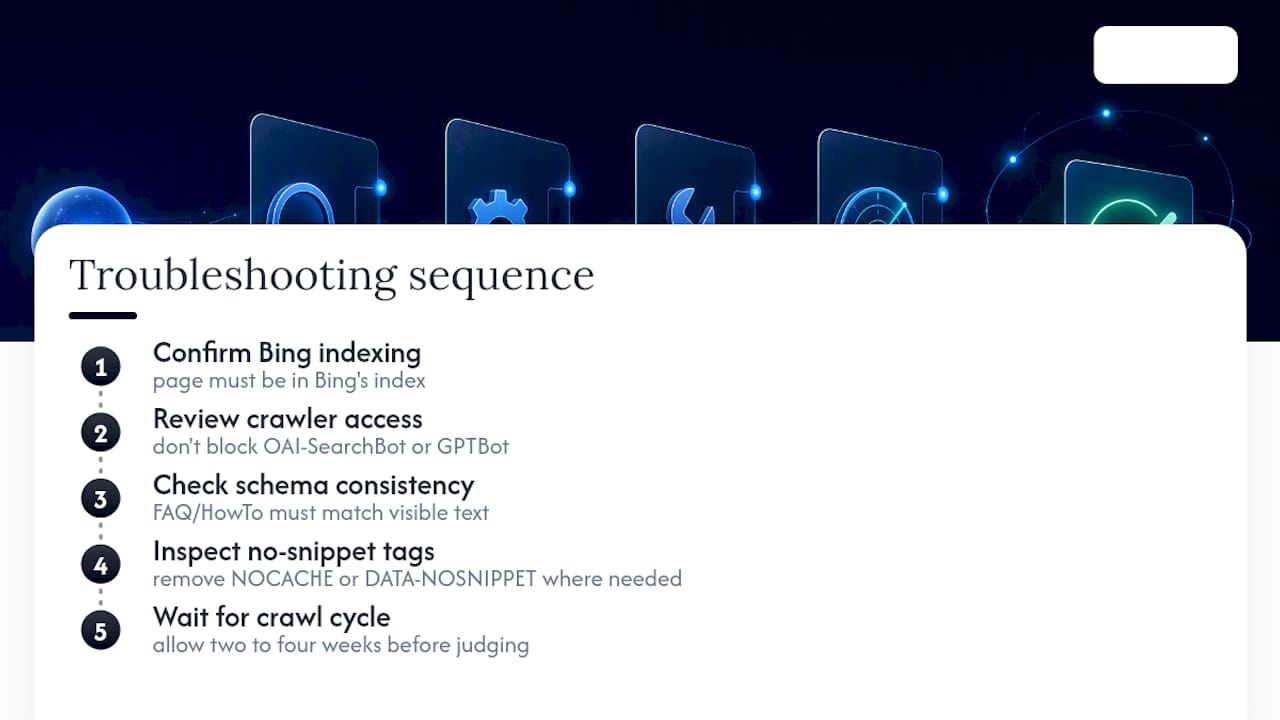
The most frequent mistake is fixing passage writing before confirming indexing. If a page isn't in Bing's index, no amount of rewording earns a citation, so always check coverage first.
Blocking OAI-SearchBot or leaving GPTBot access undecided is another common gap. Many sites default to blocking every unfamiliar crawler in robots.txt without realising it removes them from AI answer eligibility entirely. Review your robots.txt deliberately rather than inheriting a default configuration.
Schema mismatches cause quiet damage too. FAQPage markup that doesn't match the visible question and answer text, or HowTo schema listing steps that differ from what's on the page, can undermine trust signals rather than build them. Copilot's synthesis layer is checking for consistency, not just presence of markup.
Overusing NOCACHE or DATA-NOSNIPPET tags on pages you actually want cited is a surprisingly common oversight, often left over from an old privacy policy applied site-wide rather than page by page.
Finally, expecting overnight results causes people to abandon good work early. Indexing changes can take days to propagate even with IndexNow enabled, and citation patterns shift gradually as freshness and corroboration signals accumulate. Give a fix at least a full crawl cycle, generally two to four weeks, before concluding it hasn't worked.
Impact of Bing Copilot optimization on user engagement metrics and ranking
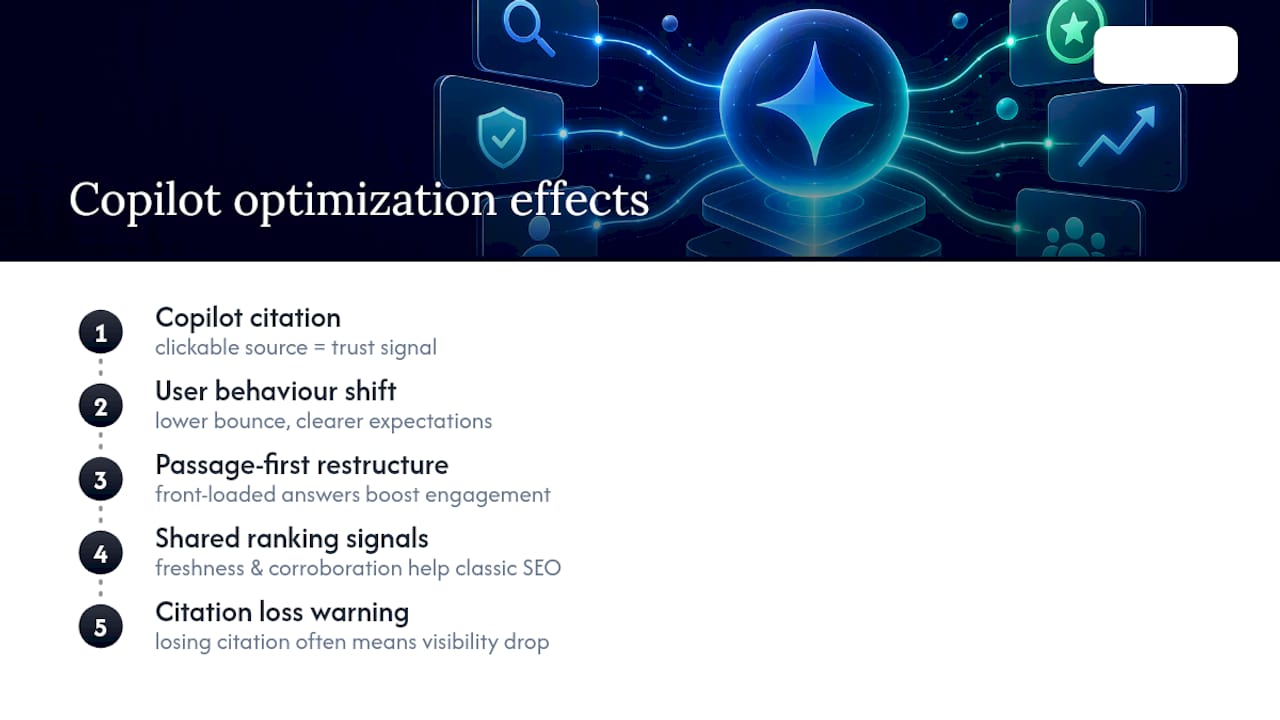
Being cited in Copilot changes user behaviour before they even reach your site. A citation with a clickable source link acts as a trust signal, and users arriving from that click tend to already understand roughly what they'll find, which generally lowers bounce rates compared with a cold organic click.
Passage-first restructuring, done for Copilot's benefit, tends to improve on-page engagement metrics regardless of whether Copilot ever cites the page. Clear, front-loaded answers reduce the time users spend scanning for relevance, which shows up in dwell time and scroll depth even for visitors arriving through classic search.
There's a compounding effect worth noting: the freshness and corroboration signals that improve Copilot citation odds are the same signals Bing's classic ranking algorithm weighs. Pages restructured for passage clarity often see modest classic ranking improvements alongside any citation gains, because both systems are ultimately rewarding the same underlying qualities: clear structure, credible sourcing, and answers that don't make the reader work.
The reverse also holds. A page that loses a Copilot citation to a competitor is usually losing classic search visibility on the same query too, since the retrieval gate is shared infrastructure. Treating Copilot citation loss as an isolated AI problem, rather than a broader visibility signal, means missing the earlier warning it's giving you about classic search performance as well.
What actually matters, and what conventional SEO advice gets wrong
Most advice on this topic treats Copilot optimisation as a content problem first. It isn't. In every audit pattern that holds up, the gating failure sits in the plumbing: blocked crawlers, missing IndexNow, broken canonicals, pages that never reached Bing's index in the first place. Writing advice gets all the attention because it's easier to sell as a service, but it's the second problem, not the first.
The conventional wisdom also overstates how much schema alone can do. Structured data helps Copilot match a passage to a query; it does not manufacture eligibility for a passage that's vague, badly sourced, or contradicted elsewhere on the web. Markup is a signal amplifier, not a substitute for a genuinely answerable sentence.
What the reader should prioritise first is unglamorous: confirm the page is indexed, confirm the crawlers you want are actually allowed in, confirm IndexNow is firing. Only once that layer is solid does rewriting a heading into a direct fifteen-word answer start to earn its keep. Skipping straight to passage rewriting on an unindexed site is the single most common wasted effort I see in this space, and it's avoidable with a five-minute check most teams simply never run.
— Tom Heaton
Why book Cited's free AI visibility audit
Fixing Copilot eligibility yourself means juggling Bing Webmaster Tools, IndexNow submissions, schema validation, and passage rewrites across dozens of pages, usually alongside everything else on your plate. Cited runs that full diagnostic for you in one pass and tells you exactly which layer is failing: indexing, schema, passage structure, or authority signals.
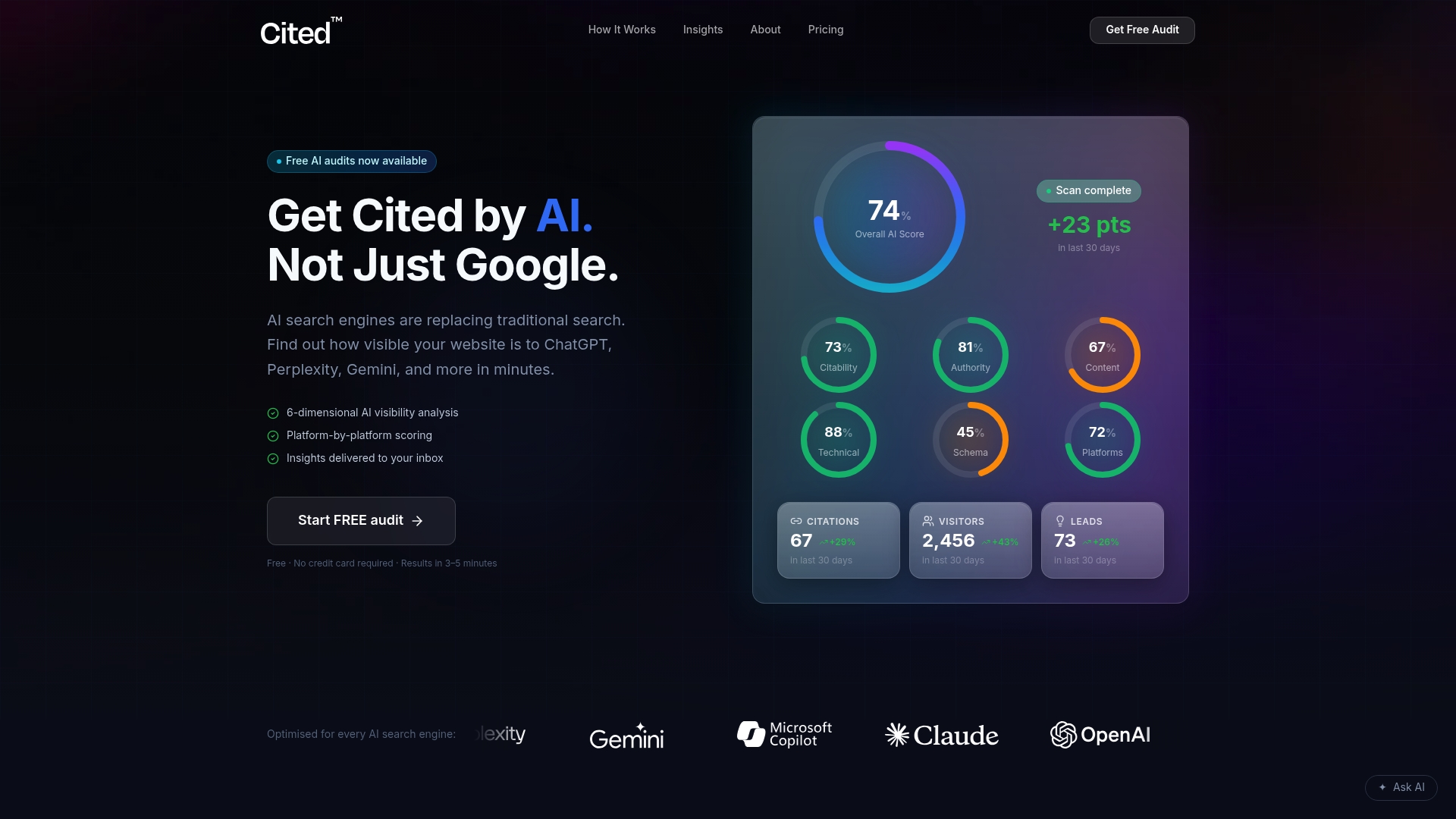
The free audit checks your site across all six dimensions that determine AI citability, then hands you a prioritised list of what to fix first. If you'd rather have it implemented rather than DIY it, Technical Fixes start at £495 as a one-off project, with an AI Optimised managed service at £995 a month for ongoing work, and custom Enterprise engagements for larger sites. You can read exactly how the scoring works on our methodology page before committing to anything.
Start with the audit at cited.best/audit and book a call whenever you're ready to move from diagnosis to fixes at Cited.
Sources
Go straight to Microsoft's own documentation before relying on third-party interpretation. The Copilot blog post on AI search improvements explains the citation display changes directly. Microsoft's guidance on optimising content for AI search inclusion covers the technical and structural requirements in detail, and the Bing Webmaster Tools AI Performance announcement is worth bookmarking for ongoing measurement. For a wider industry view, Flock's breakdown of Bing ranking factors for Copilot offers a useful supplementary perspective.
- Introducing AI Performance in Bing Webmaster Tools Public Preview
- Bringing the best of AI search to Copilot
- Optimizing your content for inclusion in AI search answers
FAQ
Why is Microsoft Copilot so slow sometimes?
Copilot's response time depends on how many sources it retrieves and synthesises per query, so complex or multi-source questions naturally take longer than a simple lookup. Heavy server load during peak usage periods can also add delay.
Is Bing actually better than Google?
Neither is universally "better"; Bing integrates more directly with Copilot's citation display and Microsoft's own AI tools, while Google's strength lies in classic search volume and its own AI Overviews. For citation-first content strategy, Bing indexing matters specifically because it's the entry pool for Copilot.
Does Bing use Copilot?
Yes, Copilot is built on Bing's search index and ranking infrastructure, which is why Bing indexing is a prerequisite for Copilot citation rather than a separate, optional step.
How long does it take to get cited by Copilot after fixing technical issues?
Indexing changes typically take days to propagate even with IndexNow enabled, and citation patterns build gradually as freshness and corroboration signals accumulate, so allow at least two to four weeks before judging results.
What's the fastest way to check if Copilot is citing my site?
Run neutral, non-branded prompts related to your topic directly in Copilot and note which URLs appear, then cross-check against the AI Performance data in Bing Webmaster Tools for a fuller picture over time.
Recommended
Ready for your AI score?
See how visible your site is to ChatGPT, Perplexity & Gemini.
Start FREE auditResults in minutes · 100% free