
If you want AI search engines like ChatGPT and Copilot to cite your content, focus on four technical fundamentals: ensure AI crawlers can access your pages, write a 40-60 word answer capsule under every question heading, add properly structured schema markup, and publish an llms.txt file listing your best pages. Research shows answer capsules appear in 72% of cited posts, making them the single strongest predictor of getting quoted by AI systems.
C2PA for AI: an implementation playbook for AI citations
C2PA for AI, in this guide, means the audit and technical fixes that raise the odds of your site being cited by AI search engines, not the media provenance standard of the same acronym. If you want results, run a free AI audit and prioritise four things: crawler access, an answer capsule on every key page, FAQPage schema, and an llms.txt file. Get those right and platforms including Bing Copilot start finding your content within days.
- Run a free audit before spending on fixes: cited.best/audit
- Fix crawler access and schema before touching content style
- Validate every schema change with the Google Rich Results Test
Pro Tip: *An audit of nearly two million sessions found that answer capsules were the single strongest predictor of ChatGPT citations, present in 72.4% of cited posts. Start there.*
Key Takeaways
AI citation depends on crawler access, link-free answer capsules, and correctly wired schema working together, not any single fix in isolation.
Point | Details |
|---|---|
Answer capsules drive citations | Write a 40 to 60 word, link-free answer under every question heading; 72.4% of cited posts include one. |
Schema needs graph structure | Wire Organization, Person, and Article nodes together with |
Crawl access is non-negotiable | Allow AI bots in robots.txt and confirm server-side rendering, or none of the schema work matters. |
Timelines vary by query type | Technical fixes show within days; citation lift is typically measurable in 4 to 12 weeks. |
Cited delivers audit through implementation | Free audit, £495 Technical Fixes, and £995 monthly AI Optimised cover audit to ongoing monitoring. |
Table of Contents
- What is C2PA for AI and what should you fix first?
- How do you build a roadmap from audit to deployment?
- What do working JSON-LD patterns actually look like?
- How long does it take to see AI citation results?
- What mistakes stop pages getting cited?
- What criteria matter when choosing an AI visibility vendor?
- What should you ask a vendor before signing?
- What red flags should make you walk away?
- How Cited turns an audit into measurable AI citations
- Sources
- FAQ
What is C2PA for AI and what should you fix first?
C2PA for AI, as businesses use the term when they mean AI visibility work, covers the technical and content changes that make a page easy for AI systems to find, parse, and quote. That includes crawl permissions, structured data, and the prose itself. Get the fundamentals wrong and no amount of content polish will help; get them right and even modest sites start showing up inside ChatGPT, Perplexity, and Copilot answers.
The highest-leverage actions, in priority order:
- Write answer capsules. Place a 40 to 60 word direct answer under every question-style heading, with no links inside it. Cited posts with a clean, link-free capsule get quoted far more often than pages that bury the answer under three paragraphs of throat-clearing.
- Deploy Article, FAQPage, Person, and Organization schema, wired together with
@idand@graphso the entities reference each other consistently across the site. - Publish an llms.txt file at your domain root, listing 10 to 25 canonical pages you want AI systems to treat as authoritative.
- Allow AI crawlers in robots.txt and confirm key pages render server-side, since JavaScript-only content is often invisible to AI bots.
- Add Person blocks for named authors, with Organization.sameAs links pointing to verified profiles such as LinkedIn or Companies House.
Keep outbound citations in the supporting paragraphs beneath each capsule, never inside it. A capsule stuffed with links reads as marketing copy, not a fact a model can lift cleanly.
How do you build a roadmap from audit to deployment?
An AI visibility project runs in four stages: audit, fix, deploy, monitor. Each has a distinct deliverable and a realistic timeframe, and skipping stages is the single biggest cause of wasted budget.
- Audit. Check crawl permissions, review robots.txt, draft an llms.txt file, and sample five to ten pages for missing schema and weak answer capsules. A free audit from Cited produces this as a scored report across six citability dimensions, so you know exactly what to fix before paying for anything.
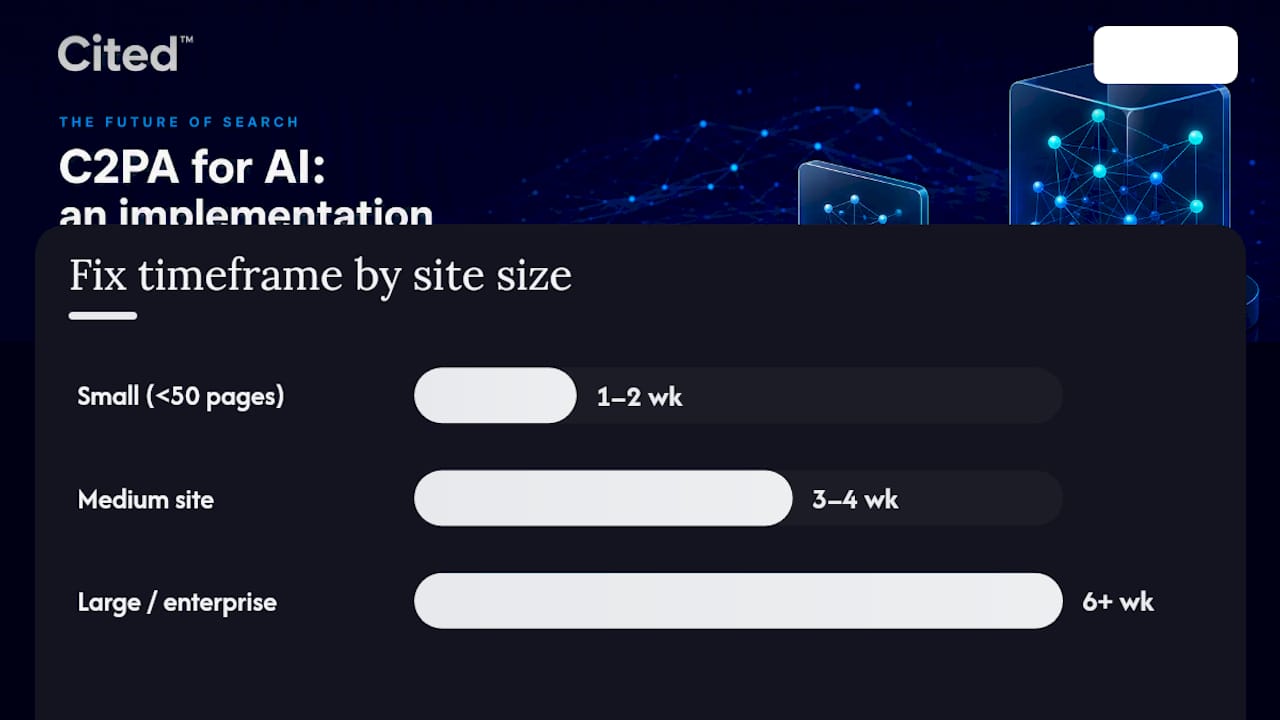
- Fix. This is where server-side rendering gets sorted, robots.txt gets adjusted for AI user agents, JSON-LD templates go in, and answer capsules get rewritten. Small sites (under 50 pages) usually take one to two weeks; medium sites three to four weeks; large or enterprise sites can run six weeks or longer depending on how much content needs rewriting.
- Deploy and validate. Every schema change gets checked through the Google Rich Results Test and Validator before going live. Technical readiness also means confirming that OAI-SearchBot, ClaudeBot, and PerplexityBot can actually reach the content, not just that Googlebot can.
- Monitor. Sample the same set of queries weekly across ChatGPT, Perplexity, Gemini, and Copilot, and track AI referral sessions in GA4 as a distinct channel.
Pro Tip: Don't wait for the full fix phase to finish before validating schema. Run each template through the Rich Results Test as you build it, so errors get caught one template at a time rather than in a pile at launch.
On cost: the audit is free. Technical Fixes run £495 as a one-off for the schema, robots.txt, and llms.txt work described above. AI Optimised, the ongoing managed service, is £995 per month and includes continued monitoring, content edits, and schema maintenance as AI platforms change their extraction behaviour. Enterprise projects with multiple domains or complex CMS constraints are quoted individually.
What do working JSON-LD patterns actually look like?
The pattern that performs best for AI extraction is an entity graph built with @graph and stable @id values, not a scattering of isolated schema blocks. One Organization node, one Person node per author, and one Article node that references both, all sharing the same domain-rooted @id structure so a crawler can resolve who wrote what and who published it.

A minimal FAQPage entry should mirror the visible page exactly:
```
{
"@type": "Question",
"name": "How long does AI citation take to show up?",
"acceptedAnswer": {
"@type": "Answer",
"text": "Crawl and schema fixes are often visible within days; citation lift typically shows in 4 to 12 weeks."
}
}
```
The name field must match the visible H3 word for word. Google and AI parsers both flag mismatches, and a mismatched block frequently gets ignored entirely rather than partially trusted. For HowTo schema, keep the step array between three and eight entries. More than that and platforms tend to truncate or skip the block rather than quote it in full.
- Run every new schema block through validator.schema.org and the Google Rich Results Test before deployment.
- Fix every warning, not just errors. Warnings often flag the exact mismatches that stop extraction.
- Keep author
sameAslinks pointing to real, verifiable profiles.
Pro Tip: Keep the schema text identical to the visible answer text on the page. A model that finds two conflicting versions of the same fact usually cites neither.
How long does it take to see AI citation results?
Technical fixes such as robots.txt changes and schema validation are often visible within days. Citation lift, meaning your content actually getting quoted, typically becomes measurable within 4 to 12 weeks, and that spread depends heavily on whether the query relies on live retrieval or training-data synthesis. ChatGPT works on a dual-path model: current queries route through Bing retrieval and can shift within days of a fix, while stable topics draw on training data and shift only as broader authority builds over months.
Track four things weekly:
- Citation share across a fixed set of sampled prompts run through ChatGPT, Perplexity, Gemini, and Copilot.
- AI referral sessions in GA4, grouped as their own channel rather than lumped into "other."
- Position inside AI answers, since being cited third among five sources behaves differently to being cited first.
- Verbatim lift frequency, tracking how often your exact phrasing appears rather than a paraphrase.
Report on a monthly cadence at minimum. A dashboard covering these four metrics gives a technical buyer something concrete to show a finance director, rather than a vague claim that "AI visibility is improving."
What mistakes stop pages getting cited?
Most failed implementations share the same handful of errors, and they are almost always fixable once spotted.
- Buried answers. Three paragraphs of preamble before the actual answer means most models never reach the fact worth quoting.
- Schema mismatches. JSON-LD that says one thing while the visible page says another gets ignored by validators and often by the AI parser too.
- Crawler blocks. A robots.txt that excludes AI user agents, or content rendered only in JavaScript, is invisible to bots that never execute scripts.
- Linked capsules. Dropping internal or external links inside the answer block makes it read as promotional copy rather than a citable fact, and link density inside capsules correlates negatively with citation rates.
- Schema without prose. Structured data clarifies entities but doesn't replace authoritative writing. A page with perfect JSON-LD and thin, generic content still won't get quoted over a competitor with better prose.
What criteria matter when choosing an AI visibility vendor?
Look for three things: proven technical delivery, transparent scoring, and ongoing accountability. A vendor should show you a real audit methodology, not a vague promise of "AI optimisation." Ask to see how they score the six dimensions that actually affect citation: technical health, schema coverage, authority signals, platform coverage, content structure, and crawl access.
Pricing transparency matters as much as the work itself. A vendor quoting a flat monthly fee with no explanation of what's included, or one that won't separate a one-off technical fix from an ongoing managed service, is harder to budget against and harder to hold accountable. Cited's structure, a free audit, a fixed £495 technical fix, and a £995 monthly optimisation tier, gives a buyer a clear ladder to climb rather than a single opaque retainer.
Delivery speed is another differentiator. Ask how long the audit takes to turn around and how long fixes typically take for a site your size. A vendor who can't give you a timeframe for small, medium, and large sites hasn't done enough of this work to know.
Finally, check whether the vendor validates its own output. Anyone deploying schema should be running it through validator.schema.org and the Google Rich Results Test as standard practice, not as an afterthought you have to request.
What should you ask a vendor before signing?
A handful of direct questions separate a genuine implementation partner from a reseller of generic SEO advice.
Ask how they measure baseline citability before quoting a fix. If there's no audit step, there's no way to know whether the £495 or £995 spend is solving the right problem. Ask for an example of an entity graph they've deployed, specifically how they wire @id values across Organization, Person, and Article nodes. A vendor who can't answer that concretely probably hasn't built one.
Ask which AI platforms they monitor and how often. Weekly sampling across ChatGPT, Perplexity, Gemini, and Copilot is a reasonable minimum; monthly or "on request" monitoring won't catch shifts fast enough to matter.
Ask what happens after the technical fixes ship. Does the relationship end, or is there an ongoing service that adjusts as platforms change their extraction behaviour? Ask for a straight answer on timelines: when will crawl fixes show up, and when might citation lift become measurable. Anyone promising overnight results across the board isn't being straight with you.
What red flags should make you walk away?
Vague promises are the biggest warning sign. Anything guaranteeing "guaranteed AI citations" or a specific citation count within a fixed number of days ignores how ChatGPT's dual-path retrieval model actually works. Some queries route through live Bing retrieval and can shift quickly; others depend on training data and authority built over months. No honest vendor controls that timeline completely.
Watch for vendors who won't show you a sample audit or scoring methodology before you commit budget. If the pricing structure is a single opaque monthly fee with no breakdown of technical fixes versus ongoing optimisation, you have no way to judge whether you're paying for real work or a subscription that renews itself indefinitely.
Be wary of anyone recommending schema changes without validation. If a vendor pushes JSON-LD live without running it through the Rich Results Test or validator.schema.org first, expect mismatches that silently break extraction. And be sceptical of any provider that treats content and technical work as separate problems. Schema without citation-worthy prose rarely earns a citation, and prose without correct crawl access never gets seen at all.
What should you fix first if budget is tight?
If I had to choose three things to fix before anything else, it would be crawler access, answer capsules, and Article plus FAQPage schema with proper @id wiring. Together those three create the minimum surface a model needs to find a page, understand what it's about, and lift a clean fact from it. Everything else, from llms.txt to deeper authority building, compounds on top of that foundation. Cited's free audit at cited.best/audit tells you exactly where those three stand on your site before you spend a penny fixing them.
How Cited turns an audit into measurable AI citations
Cited runs the free audit, then does the fixing, rather than handing you a PDF and leaving you to brief a developer. That's the practical difference between this and hiring a generalist agency: you get a scored report across six citability dimensions, then an implementation team that actually ships the schema, the llms.txt file, and the crawl fixes rather than just recommending them.
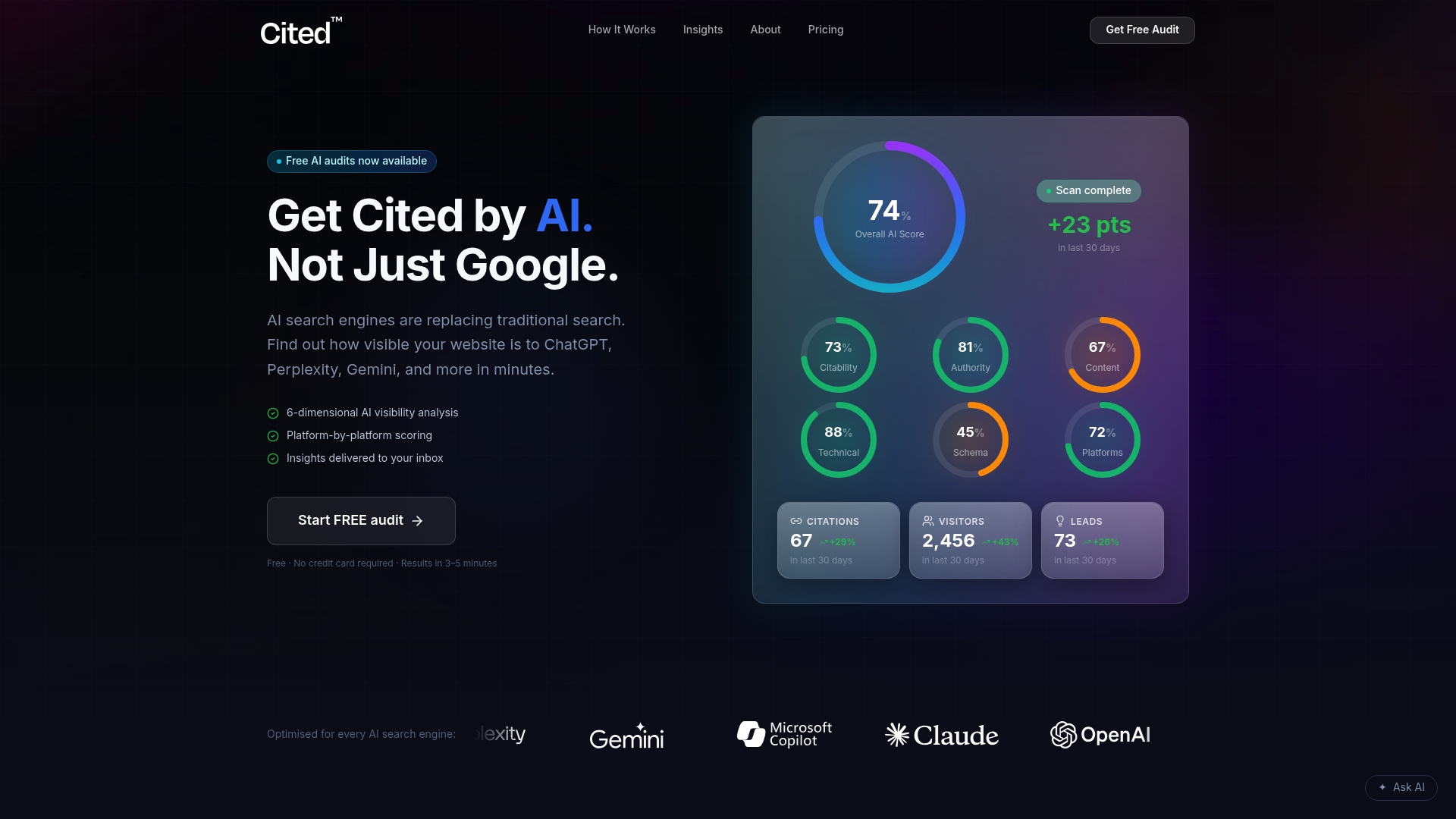
The Technical Fixes package, £495 one-off, covers the audit findings that need direct implementation: server-side rendering checks, robots.txt adjustments, JSON-LD templates for Article, FAQPage, Person, and Organization, and a drafted llms.txt file. The AI Optimised service, £995 per month, adds ongoing monitoring across ChatGPT, Perplexity, Gemini, and Copilot, plus content edits as extraction patterns shift. Enterprise projects with multiple domains or complex platforms get a custom quote. Full detail on what each tier delivers sits on the methodology page and the how it works page.
If you want to know where your site stands before spending anything, check your AI visibility and book the free audit. It's the fastest way to see which of the fixes above your site actually needs.
Sources
Keep these open in the same session as any deployment:
- How to get cited by ChatGPT: The content traits LLMs quote most
- Schema.org for AI
- How ChatGPT chooses sources: the complete citation mechanics guide (2026)
Save the free audit and the Cited methodology page as your next two stops after reading this.
FAQ
What does C2PA for AI mean in this context?
Here, it means AI visibility optimisation: the audit and technical fixes (schema, crawl access, llms.txt) that raise a site's odds of being cited by AI search engines. It isn't the media provenance standard sharing the same acronym.
How long before AI citation improves after fixes?
Crawl and schema fixes are usually visible within days. Measurable citation lift typically takes 4 to 12 weeks, depending on whether the query uses live retrieval or training-data synthesis.
What should an answer capsule contain?
A direct, self-contained answer of 40 to 60 words, placed immediately under a question-style heading, with no links inside it. Link-free capsules correlate strongly with ChatGPT citations.
Do I need llms.txt if I already have good schema?
Yes. Schema and llms.txt serve different purposes: schema clarifies entities on a page, while llms.txt curates which pages across your whole site an AI crawler should treat as canonical.
What does Cited's free audit actually check?
It scores your site across six citability dimensions, technical health, schema coverage, authority, and platform coverage among them, and identifies which fixes would raise your citation likelihood most. Run it at cited.best/audit.
Recommended
Ready for your AI score?
See how visible your site is to ChatGPT, Perplexity & Gemini.
Start FREE auditResults in minutes · 100% free